marine cargo insurance
Strait of Hormuz
Strait of Hormuz impact on global trade
Risks to Commercial Cargo in the Strait of Hormuz: Insurance Insights

Maria Paula Rodríguez
The sinkings of the GFS Pride and the Cape Dao confirm that the risk in the Strait of Hormuz is no longer limited to oil tankers. Containers, dry cargo, and other commercial goods are also being put at risk. For importers and exporters, the question is no longer just whether the vessel will reach its destination, but whether the insurance coverage they have purchased adequately addresses the type of risk the operation faces.
The Strait of Hormuz once again took center stage in the international shipping industry this week.
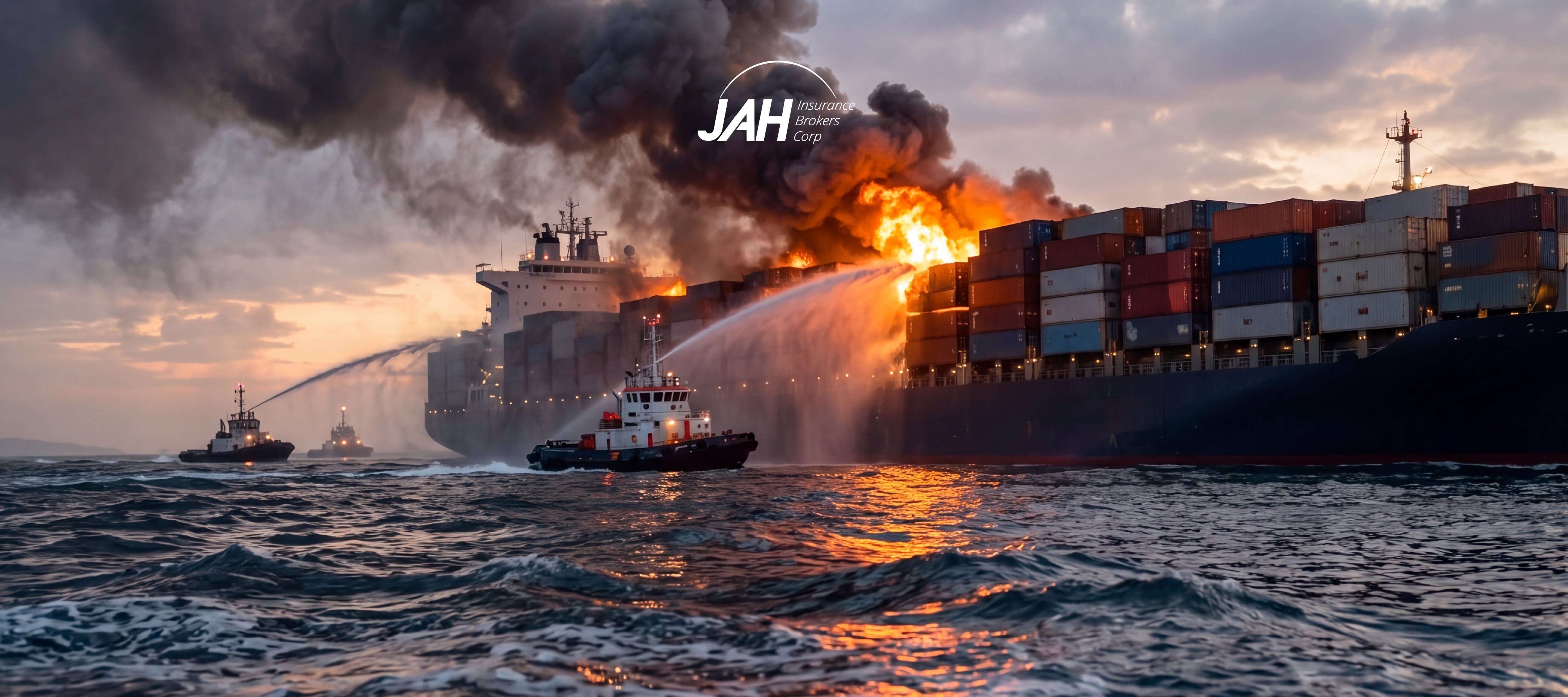
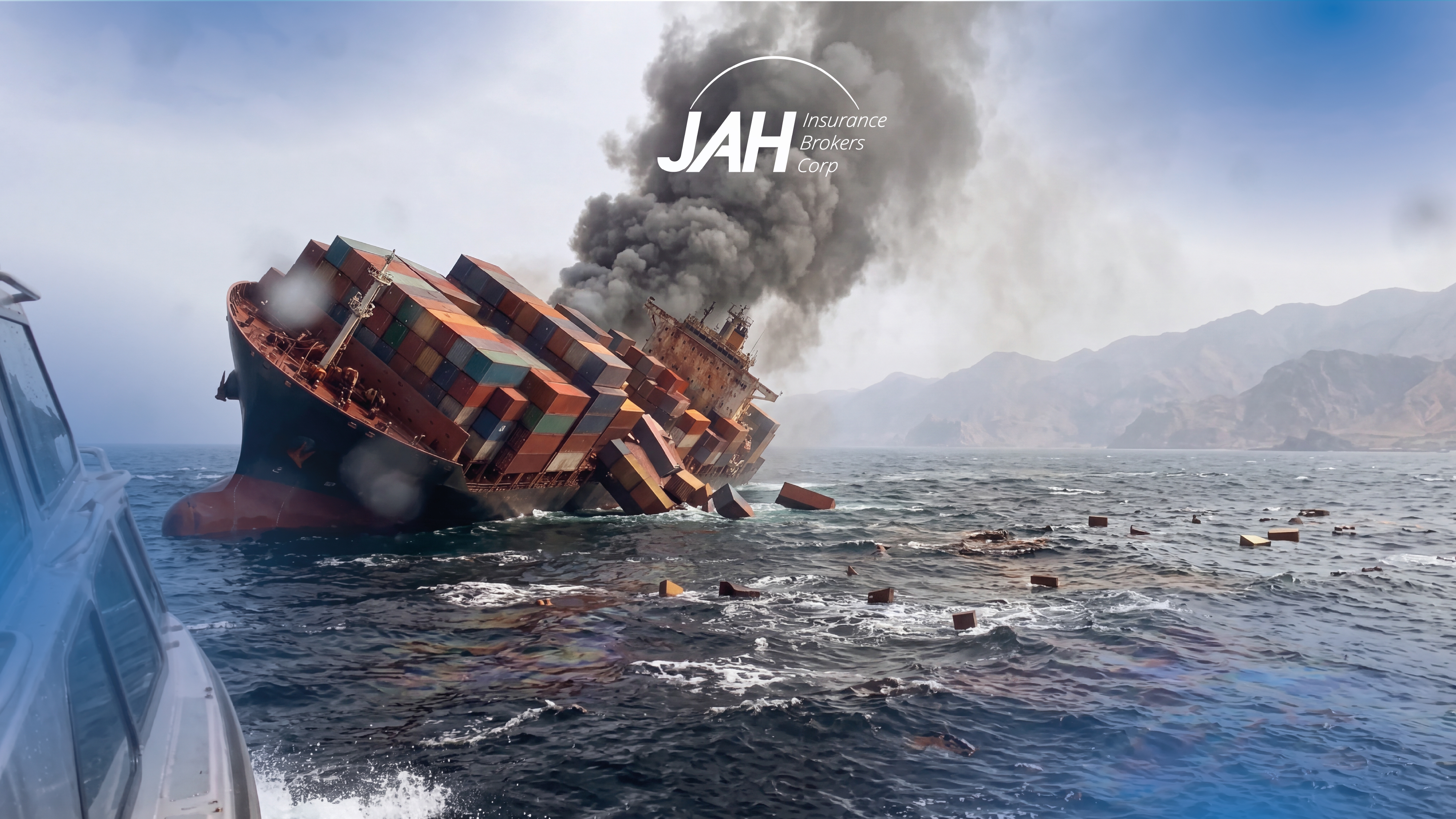
In less than 24 hours, two commercial vessels were reported sunk after coming under attack. The first was the GFS Pride, a Singapore-flagged container ship with a nominal capacity of 2,824 TEU, which sustained damage and caught fire while transiting the strait on October 13. The 21 crew members were evacuated, and according to the Singapore Maritime and Port Authority, no injuries were reported. The International Maritime Organization subsequently confirmed the sinking.
The second incident involved the Cape Dao, a bulk carrier flying the flag of Antigua and Barbuda that had been struck by a projectile on September 23. After weeks of damage and salvage efforts, it eventually sank in the vicinity of the strait. One crew member died in the initial attack.
The timing of these incidents is significant, but there is something even more relevant for those who transport goods.
The attacks are no longer affecting only tankers.
Containers and dry cargo are also at risk.
A Growing Problem
Since the start of the conflict, the IMO has documented a series of incidents involving commercial vessels in and around the Strait of Hormuz. As of October 14, the organization had recorded 113 confirmed incidents in the region. Among the most recent are container ships, oil tankers, and other types of vessels hit by projectiles, fires, or damage while at sea.
It is important to clarify: those 113 figuresrefer to confirmed incidents in the area; they do not mean that 113 ships have been sunk.
The trend, however, is indeed cause for concern.
| Situation | Vessel / Situation | What happened |
|---|---|---|
| March 2026 | Safeen Prestige | Container ship struck by a projectile; subsequently reported to have sunk |
| September 23 | Cape Dao | Bulk carrier struck by a projectile near Oman |
| October 11 | Several ships | Multiple attacks and instances of damage were reported |
| October 13 | GFS Pride | Container ship attacked, set on fire, and subsequently sunk |
| October 13 | GFS Giselle / Al Saadiyat | Commercial ships damaged |
| October 14 | New incidents | UKMTO reported new attacks on ships in transit |
As of September 16, the IMO had recorded 80 attacks on merchant ships and at least 22 deaths among seafarers. Less than a month later, its regional tally had already reached 113 confirmed incidents.
Why is the Strait of Hormuz so important?
The strait connects the Persian Gulf with the Gulf of Oman and the Arabian Sea and is one of the world’s major energy chokepoints.
According to the U.S. Energy Information Administration, during the first half of 2025 , approximately 20.9 million barrels per day of crude oil and petroleum liquidspassed through the Strait of Hormuz , equivalent to about 20% of global consumption of petroleum liquids and roughly one-quarter of global seaborne oil trade.
But the importance of the Strait of Hormuz is not limited to oil. When risk increases at such a narrow and strategic point, the consequences ripple through the rest of the logistics chain. Routes change, transit times increase, shipowners’ decisions are altered, and higher costs related to security, fuel, freight, and insurance arise.
The risk to cargo extends far beyond a shipwreck
Let’s imagine a simple operation. A company purchases machinery, spare parts, or finished goods in Asia. The goods travel by container to a port in the Gulf and must then continue on to another destination.
If the ship is attacked, there are several possible scenarios:
-
The cargo may suffer direct physical damage.
-
A fire, explosion, or floodingmay occur .
-
The ship may be disabled and require assistance or salvage.
-
The containers may have to be unloaded, stored, or transferred to another ship.
-
The cargo may end up at a port other than the one originally intended.
And in the worst-case scenario, as just happened with the GFS Pride, the vessel may sink.
The problem for the cargo owner is that each of these scenarios may trigger different coverage provisions or be subject to different exclusions.
Therefore, if your cargo is transiting through a conflict zone, simply having insurance isn’t enough: you must verify that your policy’s coverage and exclusions correspond to the specific risks of the route.
War and Accidental Damage: The Difference You Need to Check in Your Policy
The cause of the damage matters just as much as the damage itself. The Institute Cargo Clauses (A), (B), and (C), used as a reference in international cargo insurance, establish different scopes of coverage. Clause A offers the broadest coverage of the three, but it does not eliminate exclusions: it also covers risks of war, capture, detention, and certain damages caused by weapons of war, which must be reviewed according to the applicable policy language.
If your shipment passes through a conflict zone, the question isn’t just “Is my cargo insured?” but “Does my policy cover the specific risks my goods face on this route?”
The Institute War Clauses (Cargo) address certain war risks excluded from standard cargo clauses. Their scope is subject to their own terms, conditions, and exclusions; therefore, you should not assume that they are included or that they cover any event related to the conflict. You must review the coverage you have actually purchased. Source: If Insurance.
In the Strait of Hormuz, this distinction has a practical implication: before shipping, you should compare the risks of the route with the terms of your policy. The U.S. maritime advisory cited for the Persian Gulf, the Strait of Hormuz, and the Gulf of Oman warns of attacks by missiles, unmanned aerial vehicles, and unmanned vessels, as well as other hazards to navigation. Source: U.S. Maritime Administration (MARAD).
It’s Not Just an Insurance Issue
The UKMTO continues to report incidents involving commercial vessels in transit. On October 14 alone, it recorded two incidents in which container ships were struck by projectiles while passing through the strait; both vessels reported minor damage and were able to continue their voyage.
The official U.S. recommendation for vessels operating in the area includes conducting a pre-voyage risk assessment, monitoring maritime communications, and coordinating navigation with the relevant authorities. It also warns of GNSS interference, spoofing, and jamming, which can compromise the accuracy of navigation position data.
The IMO, for its part, has been even more emphatic. In June, it stated that there could be no safe passage through the strait under the conditions at that time and reiterated that the safety of seafarers must take precedence over any commercial considerations.
What should a company review before shipping its cargo?
For an operation passing through an area of high geopolitical risk, we recommend reviewing at least five points.
| What to Review | Why it matters |
|---|---|
| Entire route | The risk may begin before reaching the strait and continue after leaving it. |
| Type of coverage | Comprehensive cargo coverage does not necessarily include war risks. |
| War clauses | These may be necessary when the goods are transiting through conflict-affected areas. |
| Insured value | It must correspond to the insurable interest and the terms agreed upon in the policy. |
| Changes in Route or Destination | Any detour, transshipment, or extraordinary storage must be reviewed in light of the coverage conditions. |
| Policy Coverage | Once the shipment has begun and the risk is known, modifying the coverage may be more difficult and will depend on the policy and the insurer’s approval. |
Two Different Risks, Two Solutions
A shipment may arrive on time but sustain damage, or arrive intact but too late for the operation. These are different risks and require different protections.
Cargo insurance protects the shipment against loss or damage during transit. Logistics delay insurance, on the other hand, provides coverage when a delay exceeds the contracted threshold and creates financial exposure for the operation. In the latter case, compensation is triggered based on objective records of the delay, regardless of whether the goods have suffered physical damage.
Therefore, both types of coverage can complement each other. One protects the value of the goods; the other protects the company’s financial capacity to respond when time becomes a cost. The Rescue Fund, for example, covers scenarios such as congestion, transit delays, reroutes, weather-related disruptions, rollovers, and blank sailings, with compensation that can increase depending on the duration of the delay.
In a critical operation, insuring the cargo and protecting against delays are not the same decision. They are two layers of protection.
The Message for Importers and Exporters
The sinking of the GFS Pride leaves an image that is hard to ignore: a commercial container ship, with cargo on board, can become a total loss in a matter of hours.
But the real lesson for companies shouldn’t just be to look at a map and avoid a certain route.
It should be understanding that logistics risk is changing faster than many traditional insurance policies.
A shipment may be properly packed, documented, and insured against certain physical damages, yet still be at risk if the operation enters a scenario of war, capture, detention, diversion, or disruption for which the policy was not designed.
The solution is not simply to purchase any insurance policy.
It lies in aligning the coverage with the route, the goods, the insured value, the modes of transportation, and the actual risk scenario.
What We Recommend Reviewing Today
If you have goods in transit or are preparing a shipment that could be affected by the situation in the Middle East, check the following before shipping:
1. The entire route of the shipment.
Not just the port of origin and destination.
2. The exclusions in your policy.
Especially war, capture, detention, terrorism, and related risks.
3. Whether you need specific war coverage.
The answer will depend on the policy and the market conditions applicable to the transaction.
4. Possible scenarios involving rerouting or transshipment.
A maritime contingency can quickly change the originally contracted route.
5. Whether you also have financial exposure to delays.
Because a shipment may arrive intact and still result in a financial loss.
Sources consulted
- International Maritime Organization (IMO), record of confirmed incidents in the Middle East and the Strait of Hormuz. International Maritime Organization
- International Maritime Organization, statements on navigational safety and the protection of seafarers. International Maritime Organization
- UK Maritime Trade Operations (UKMTO), reports on recent incidents. UKMTO
- U.S. Maritime Administration (MARAD), Maritime Advisory 2026-011. Maritime Administration
- U.S. Energy Information Administration (EIA), analysis of key bottlenecks in energy trade. EIA
- Reuters, information on the sinkings of the GFS Pride and Cape Dao. Reuters
- Institute Cargo Clauses / Institute War Clauses, references regarding exclusions and coverage for war risks.