Not all logistics operations face the same risks, and therefore not all insurance policies apply in the same way. One of the most common mistakes in international trade is to recommend a policy without analyzing the type of merchandise, the route, handling or storage conditions.
For freight forwarders, understanding which insurance is right for each operation not only reduces risks, it makes them strategic advisors and allows them to add more value to exporters and importers. In this guide we explain how to choose the right insurance for each logistics operation, using real examples from JAH Insurance's portfolio.
Not everything is cargo insurance
One of the most common mistakes in international trade is to think that insuring goods is enough. In reality, each stage of the logistics operation represents a different risk, and not all of them are protected by a single policy.
From the moment the goods are prepared for sale until they are unloaded at destination, multiple processes, actors and assets are involved that must also be considered in the insurance strategy.
Each logistics stage exposes the cargo to different risks.
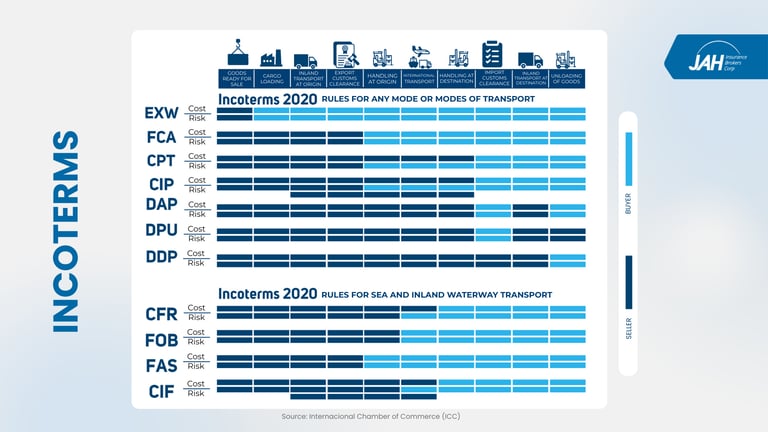
In a typical operation, risks are not concentrated at a single point:
-
Loading and handling at origin.
-
Inland transportation at origin.
-
Container use and permanence.
-
Export and import customs.
-
International transport (sea, air or land).
-
Multimodal operations (e.g. sea + land).
-
Handling and unloading at destination.
-
Temporary storage or bonded warehouses.
Insuring only the merchandise leaves important gaps
When only cargo insurance is taken out, situations such as:
-
Damage or loss of the container.
-
Risks during storage or bonded warehousing.
-
Prolonged exposure due to delays.
-
Failures in the cold chain.
-
Liabilities in multimodal operations.
Therefore, the key is not in the isolated product, but in understanding the entire logistics operation.
Insurance must be adapted to the operation, not the other way around.
A good underwriting scheme considers:
✅ The type of goods.
✅ The type of container.
✅ Whether there is storage or warehousing.
✅ Whether the operation is multimodal.
✅ If there are critical times or sensitive goods.
Each combination of operation requires a different solution, and that is where insurance becomes a true strategic ally.
Cargo insurance
This is the essential insurance to protect cargo during its transportation by land, sea or air against sudden and unforeseen events, such as theft, accidents of the means of transport, overturning, fire, natural disasters, wetting, piracy and other physical damage that may affect the merchandise from the point of origin to the point of destination, as established in the policy.
Cargo insurance is not a generic concept, it is a tool that must be adapted to the type of cargo, its condition and the way it moves within the logistics chain.
Many mistakes occur because exporters, importers and even freight forwarders are not clear about what each type of insurance actually covers.
Therefore, it is not enough to "have insurance," but to have the right insurance.
Container insurance
In many logistics operations, the focus is solely on the goods, but it is overlooked that the container is also an asset exposed to risk. Strikes, theft, partial loss, structural damage or contractual liabilities can generate costs that do not always fall on the carrier, but directly on the freight forwarder or the customer.
This risk becomes even more relevant when analyzing Incoterms. Except in the case of CIF, where the seller takes out minimal and limited insurance, in most Incoterms the container is not protected by any insurance. This means that, in the event of an event, someone will have to bear the cost, and often it is not clear who until the loss has already occurred.
Therefore, in frequent operations, high exposure routes or when the freight forwarder operates with own containers or under contractual liability, not insuring the container can become a direct loss, even when the goods are insured.
Warehousing and storage insurance
There is a false sense that the risk ends when the cargo arrives at port or destination. In practice, many goods remain for days or even weeks in warehouses, bonded warehouses or distribution centers, and during that time they remain exposed to theft, damage, fire, handling errors or external events.
Incoterms help define the extent of the seller's or buyer's liability, but they do not eliminate risk during storage. If the goods remain in a bonded warehouse, in prolonged transit or awaiting nationalization, and there is no specific insurance, any event can become a non-recoverable loss.
This type of insurance is especially relevant for customers with in-transit inventories, constantly rotating merchandise or relevant values, where a single event can affect costs, time and commercial compliance.
Reinsurance
When the temperature is worth more than the merchandise
In operations with foodstuffs, perishable products, mdicaments or sensitive cargo, the greatest risk is not always a visible accident, but a temperature variation that breaks the cold chain. This type of event does not always cause immediate and obvious damage, but can render the goods completely unusable.
Here it is important to understand that, even under Incoterms such as CIF, the insurance contracted by the seller is usually basic and does not cover specific risks such as technical failure of the refrigeration equipment or thermal deviations. The result is that the importer receives an apparently insured cargo, but with critical gaps in protection.
Therefore, this type of insurance does not replace cargo insurance, but complements it, covering a very specific risk that, if not managed, can generate total losses with no possibility of recovery.
Courier insurance
Courier shipments are often perceived as low-risk operations due to their size or unit value. However, their high frequency, less operational control and greater exposure to loss mean that, overall, they represent a significant risk.
In most Incoterms and courier services, liability is limited and indemnities are usually minimal compared to the actual value of the shipment. In the absence of adequate insurance, losses accumulate and end up affecting the customer's profitability or the business relationship.
This insurance makes sense especially for companies that handle constant volumes of small shipments, where a single loss may not be critical, but several are.
Delay insurance
In many logistics operations, the biggest impact is not the physical loss of the goods, but the failure to meet agreed deadlines. Contractual penalties, production stoppages, loss of customers or commercial defaults are real consequences of a delay.
Incoterms define who bears costs and risks to a certain extent, but they do not protect the economic impact of a delay, even when the goods arrive in good condition. This is one of the most overlooked risks for exporters and importers. In just-in-time operations, date-sensitive goods or strict contractual commitments, not having this type of protection can generate significant financial losses, even when the cargo is insured.
In international trade, risk depends not only on the goods, but also on how, when and under what conditions they move. Understanding this is what allows freight forwarders, exporters and importers to make informed decisions and fully protect their operation.


-1.jpg?width=4000&height=1852&name=banners%20mail%20radica%20tu%20PQRS%20(3)-1.jpg)