foreign trade
Supply chain risks
Colombian floriculture
.png?width=2000&height=889&name=seguro-carga-segun-tipo-mercancia.jpg%20(1).png)

In international trade, not all goods face the same risks. However, one of the most frequent mistakes is to insure different types of cargo under the same criteria, without considering their nature, fragility, value or logistical handling.
Choosing the right insurance depends not only on the route, but mainly on the type of goods. Understanding this difference allows freight forwarders, exporters and importers to avoid gaps in coverage, economic losses and unnecessary conflicts. In this guide we explain how to choose the right insurance according to the type of goods, and why a bad decision can be much more costly than the insurance itself.
Each type of merchandise has a different behavior against:
Shocks and vibrations
Handling during loading and unloading
Temperature changes
Transit times
Storage conditions
A load that withstands an impact may not withstand a thermal variation. Another may withstand handling, but not a delay. This is why insurance must be adapted to the goods, not the other way around. Even if the goods are not delicate, the risk is there, and it often manifests itself in less obvious but just as costly ways.
General merchandise is often perceived as low risk, simply because it is not fragile, dangerous or oversized. However, this perception is one of the main reasons why unanticipated losses occur. Just because a commodity is considered "general" does not mean that it is exempt from theft, accidents, handling damage or unforeseen events during transport.
In practice, most general cargo claims are not total losses, but partial damage occurring during loading, transshipment, stowage or unloading. Blows, crushing, humidity or mishandling may affect only a part of the goods, but enough to generate a significant economic impact. When the insurance does not contemplate this type of scenarios, the client ends up assuming costs that were not foreseen.
Fragile goods require a different approach. In this type of cargo, a seemingly minor event can render the product completely useless. A bump during handling, prolonged vibration on the road or improper stowage can turn a "successful" delivery into a total loss from a commercial point of view.
Unlike other goods, the issue is often not whether or not a loss occurs, but how the damage manifests itself. Many times the goods arrive at destination, but cannot be marketed, used or installed. When insurance is not aligned with this reality, the customer discovers too late that the damage is not covered as expected.
This type of merchandise requires a correct prior classification and a conscious decision on the level of protection. Treating fragile goods as if they were general merchandise is one of the most common mistakes in international trade and one of the main sources of subsequent disputes between the parties.
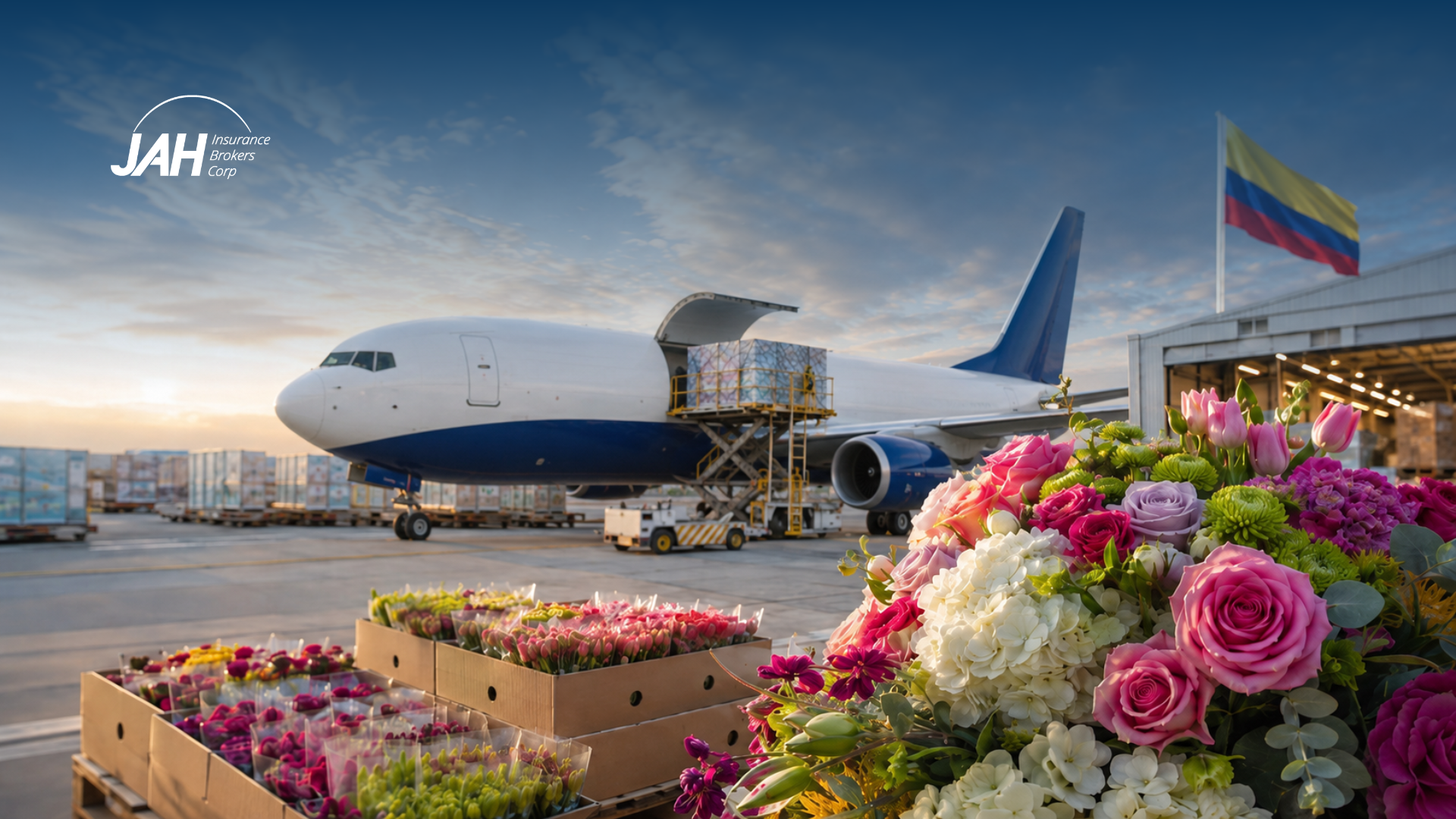
Perishable goods, such as foodstuffs, fruits, pharmaceuticals or flowers, face different risks than other cargo. In these cases, damage is not always caused by an accident, but by factors such as logistical delays, failures in the cold chain or temperature variations during transport.
A small change in preservation conditions can completely compromise the quality of the product, even if the goods arrive apparently in good condition. For this reason, securing this type of cargo requires considering not only the route, but also the transport conditions, transit times and temperature controls.
In many operations, perishable goods are insured under specialized coverages that contemplate risks inherent to the cold chain. A prior analysis of the logistics and type of product is essential to avoid losses which, in this type of cargo, can materialize very quickly.
There are goods and movements that, due to their size, complexity or operational impact, require a different analysis. These are known as special projects.
A special project is not only defined by the value of the commodity, but by the level of risk it represents to the customer's entire operation. Oversized machinery, industrial equipment, special structures or loads that require unconventional maneuvers often involve specific routes, specialized cranes, multiple transportation stages and critical times. In these cases, the slightest error can generate delays, cost overruns or losses that are difficult to recover.
In this type of operations, forcing a standard insurance is usually a mistake, because these schemes do not contemplate particularities such as special maneuvers, non-traditional routes, multiple means of transport or prolonged exposure during transit. Even when the goods arrive at their destination, the impact of partial damage can be as high as a total loss.
One of the most common mistakes in international trade is not classifying goods correctly before taking out insurance. Classification is the starting point to define what type of insurance to apply and with what level of coverage.
| Classification criteria | What is analyzed? | Why is it important for insurance? |
|---|---|---|
| Type of merchandise |
Nature of the product (general, perishable, hazardous, fragile, machinery, etc.) |
Determines the level of risk exposure and the coverages that may or may not apply. or not apply. |
| Risk level | Low, medium, high or critical critical depending on the type of cargo, route and handling |
Directly impacts the type of of policy, premium and whether it requires special conditions. |
| Condition of merchandise | New, used or critical cargo | Define if coverage is viable Full Cover, Total Loss or if it should be treated as a special project and consult expert advice. |
| Key decision | Impact on the operation |
|---|---|
| Type of insurance | Standard commodity insurance or special scheme. |
| Adequate coverage | Full Cover or Total Loss, depending on the actual risk profile. |
| Special treatment | In the case of critical, oversized or highly fragile goods, specialized advice is required. |
In freight insurance, the type of coverage is defined according to the level of protection required by the logistics operation. At JAH Insurance we work mainly with two coverage schemes: Full Cover and Total Loss, which respond to different levels of risk exposure.
Total Loss coverage is designed to protect the merchandise against sudden and unforeseen events that generate the total loss of the cargo during transportation.
In this scheme, indemnity applies when the merchandise is completely lost as a consequence of events such as:
This modality is usually used when companies seek protection against serious events involving the complete loss of the merchandise, while maintaining a more efficient premium structure.
Full Cover offers a broader level of protection, as it covers partial or total losses arising from sudden events during transportation.
In addition to the events covered under total loss, this coverage can respond to situations such as:
This type of coverage is mainly used when the merchandise presents greater exposure to risk, high value or more complex logistical conditions, and therefore requires more complete protection.
Classifying goods is not just a technical exercise: it is the first step in properly insuring a logistics operation.
By analyzing the type of goods, the level of risk and the transport conditions, it is possible to define more precisely what type of protection the cargo needs. This evaluation makes it possible to determine whether the operation requires Full Cover, Total Loss coverage, or even special conditions depending on the nature of the goods and the complexity of the shipment.
Taking the time to correctly classify the cargo helps to:
In logistics, every cargo is different. That's why correct classification is the basis for safer and more efficient underwriting decisions.
👉 You can see the complete visual guide here.
If you want to understand what type of insurance your logistics operation needs, our team can help you assess the risk profile of your cargo and define the most appropriate coverage for your transport.
Because when your cargo is properly classified, the right insurance really protects your operation.