
foreign trade
Supply chain risks
Colombian floriculture

Many logistics operators and exporters think they have everything under control... until a million-dollar claim comes along.
Almost always, the problem is not in the insurance, but in simple operational errors that are repeated every day: poorly done documentation, weak packaging, or poorly planned routes.
In this article, JAH Insurance Brokers will show you 5 common logistical mistakes that can leave you without coverage or increase your losses, and most importantly, what you can do now to prevent them.
A misspelled entry on the policy, BL or invoice can void coverage. It's as simple as that.
We have seen claims denied just for putting "electronic parts" instead of "industrial computers". That's not a technicality, that's a difference of hundreds of thousands of dollars.
What to do?
Use checklists for every shipment.
Don't delegate the review to the freight forwarder alone.
Make sure what you say you're shipping matches what your policy insures.
When damage occurs, the insurer will ask for photos of the packaging. If they see that it was not adequate for the type of merchandise, they will not pay.
This applies especially to fragile, refrigerated or high-value products.
What to do?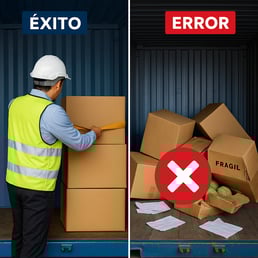
Check the minimum packaging conditions
required by your policy.
Use visible handling labels.
If your cargo needs refrigeration, make sure the packaging will support it.
Most damage does not happen on the road or at sea, but during loading or unloading.
Blows with forklifts, misuse of slings, lack of anchorages? The worst thing is that many companies don't even notice it until they open the container.
What to do?
Train yard personnel and demand handling protocols.
Use security cameras to have evidence in case of a claim.
Make sure the insurance covers from the point of loading, not just in transit.
Many people believe that their policy covers storage, transshipment or returns... but this is not the case.
There are sections that should be expressly included. If they are not, you are left unprotected in the most critical moments.
 What to do?
Ask if your policy includes the "yard-port-door" section.
Ask for extended coverage while the container is in the warehouse.
Do not accept generic policies if your operation is complex.
This mistake is costly. If the container is damaged, the shipping company charges you - no matter if it was full or empty.
Many operators end up paying for equipment they don't use, just because they didn't take out coverage for the container as packaging.
What to do?
Insure the container, even if it's not yours.
Ask for extended coverage while it remains in the yard.
Take advantage of benefits such as the container wash reimbursement we offer at JAH (up to $500).
At JAH Insurance Brokers, we have been accompanying real operations for years. We know it 's not just about selling policies, but helping you prevent problems before they cost money.
✅ Our logistics insurance protects you at key moments:
.jpg?width=299&height=299&name=White%20And%20Blue%20Minimalist%20Qr%20Code%20Placement%20Instagram%20Post%20(1).jpg)
Don't wait until you lose to check your policy.
Before your next shipment, be sure to:
☐ Check that documentation is consistent.
☐ Verify that the packaging meets technical conditions.
☐ Validate point-to-point coverage.
☐ Include the empty container in the policy.
☐ Have legal and technical support in case of any claim.
Contact us today, avoid surprises and protect your cargo and your reputation.