.jpeg?width=1600&height=711&name=WhatsApp%20Image%202026-08-28%20at%2012.51.06%20(1).jpeg)
Embarcaciones Chinas
Imports
Exports
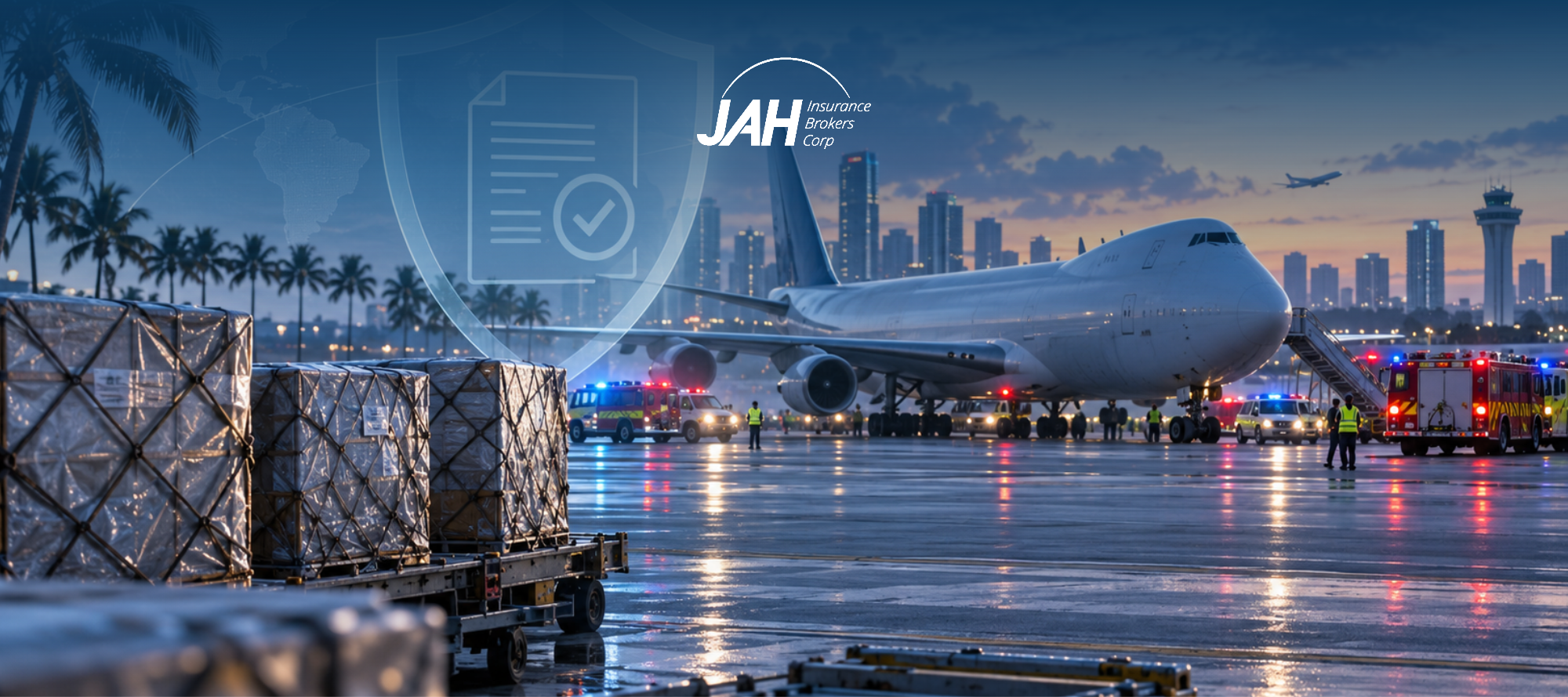

Flight 7598, operated by 21 Air for the Amazon Air network, resulted in five fatalities, several injuries, and an ongoing federal investigation. Now, as the NTSB attempts to reconstruct what happened during the final seconds of the landing, the case also raises uncomfortable questions for the air cargo industry.
When an aircraft is taken out of service, the cargo does not simply disappear from the system. It must be retrieved, rescheduled, rerouted, or wait for a new connection. And that’s where another part of the story begins.
In this edition of Brújula Logística, we review what is known so far and what lessons this accident holds for those who depend on air cargo.
On Sunday ,September 6, 2026, theaircraft—a Boeing 767-33A freighter—was arriving from San Juan, Puerto Rico, when it overshot the end of Runway 30, continued approximately 1,300 feet beyond the runway, and struck vehicles on the ground. Five people were killed and five others were injured. Both pilots survived.
The investigation is being conducted by the National Transportation Safety Board (NTSB), with the participation of the FAA. And there is something important we must make clear from the outset:
The NTSB continues to investigate.
The plane was on the third leg of its journey. Before the accident, it had flown:
Cincinnati → Miami → San Juan → Miami
During the landing in Miami, the aircraft veered off the runway, struck navigation aids, and subsequently collided with two vehicles, including a van belonging to an airport cleaning service company.
Investigators recovered both the Flight Data Recorder and the Cockpit Voice Recorder—the so-called “black boxes”—and transported them to Washington for analysis.
Preliminary data available so far indicate that the aircraft made a high-speed landing and that the pilots apparently initiated a go-around —aborting the landing and taking off again—after touching down. Subsequently, that attempt was abandoned, and the brakes were reapplied. Investigators also noted that the speed brakes and thrust reversers were not deployed.
These observations are part of the investigation and should not yet be interpreted as a conclusion regarding the cause of the accident.
| Element | Confirmed Information |
|---|---|
| Date | September 6, 2026 |
| Airport | Miami International Airport |
| Flight | 21 Air Flight 7598 |
| Operation | Cargo for the Amazon Air network |
| Aircraft | Boeing 767-33A |
| Origin | San Juan, Puerto Rico |
| Incident | Runway overrun during landing |
| Distance off the runway | Approximately 1,300 feet |
| Fatalities | 5 |
| Injured | 5 |
| Pilots | Both survived |
| Investigation | NTSB and FAA |
| Probable cause | Not yet determined |
Sources: NTSB, FAA, and Reuters.
Because it occurred at one of the continent’s most important air cargo hubs.
Miami International Airport handled approximately 3.4 million metric tons of cargo in 2025—a record for the airport—representing growth of more than 13% compared to the previous year. Additionally, about 85% of its cargo is international.
Miami serves as a major logistics hub connecting the United States, Latin America, and the Caribbean.
In 2025:
That’s why, when an accident forces the closure of runways, changes to operations, and the rescheduling of flights, the impact can be felt far beyond the airport perimeter.
Following the accident, Miami International Airport initially suspended operations. During the first few hours, more than 160 flights were canceled and approximately 325 were delayed, in addition to diversions to other airports.
Subsequently, operations began to gradually recover.
This illustrates a key principle in logistics:
An out-of-service aircraft can result in:
Unavailable aircraft
↓
Reduced cargo capacity
↓
Rescheduled cargo
↓
Missed connections
↓
Limited space on subsequent flights
↓
New ETAs
Not all cargo passing through Miami was necessarily affected.
But at a hub of this scale, an operational disruption can quickly spread to other points in the network.
The accident also comes at a time of strong growth for the sector.
Global demand for air cargo reached a record high in 2025, growing 3.4% compared to 2024. In June 2026, global demand rose another 8.5% year-over-year, while capacity grew by only 4.4%.
Air cargo is particularly important for goods where time has a very high economic value:
| Industry | Why do you use air transport? |
|---|---|
| Pharmaceutical | Time, Temperature, and Availability |
| Technology | High value and short product cycles |
| Automotive | Critical parts and production continuity |
| E-commerce | Delivery promises |
| Perishables | Limited Shelf Life |
| Aerospace | AOG components and urgent replacement parts |
| Manufacturing | Supplies that can halt production lines |
And that is precisely why, when an air route is disrupted, the problem is not always just the physical loss of goods.
Often, it’s a matter of time.
From the perspective of a company that has cargo on board an aircraft involved in an accident, several immediate questions arise:
Was my cargo damaged?
Was it destroyed?
Can it be recovered?
Will it be shipped on another flight?
Who should report the incident?
What documents should I keep?
The answer will depend on each specific operation, contract of carriage, and insurance policy.
That is why it is essential not to assume that, simply because it is an aviation accident, any loss is automatically covered.
Transportation insurance should be reviewed based on:
It’s not enough to know that “the cargo is insured.”
The right question is:
A generic description can become a problem when a loss occurs.
“General cargo” does not provide the same clarity as:
New electronic equipment, model X, 120 units.
The commercial invoice, packing list, AWB, and insurance certificate should be consistent with one another.
In the event of an accident or damage:
A good claim starts with good documentation.
Not all cargo has the same impact on a company.
A company should identify which shipments could cause:
🔴 Production stoppage
🔴 Breach of contract
🔴 Loss of a sales season
🔴 Shortage of critical spare parts
🔴 Stockouts
This analysis helps determine which shipments require additional levels of protection.
An air crash like this serves as a reminder of something basic, yet often overlooked: it’s not enough to simply know that the cargo is insured.
You also need to understand how it’s insured.
Before an air shipment, it’s a good idea to check:
In an event of this magnitude, the difference between simply having a policy and having properly structured coverage can be decisive.
And there’s another key point:
It begins before shipment, when the goods, value, route, and coverage conditions are properly defined.
Because when a loss occurs, it’s too late to figure out what was—or wasn’t—covered.
For a logistics operator, there’s another dimension to consider. When a disruption occurs, the customer rarely calls the airline first.
And they ask:
Where is my cargo?
When will it arrive?
What are our options?
Who is responsible for the additional cost?
This forces operators to evolve from a model based solely on transportation to one based on contingency management.
A good strategy should include:
| Before the operation | During a disruption |
|---|---|
| Identify critical shipments | Confirm the actual status of the shipment |
| Review alternative routes | Update ETA |
| Validate insurance | Evaluate rebooking |
| Assign responsible parties | Notify the customer |
| Review alternative suppliers | Document costs and decisions |
| Establish protocols | Activate insurance when applicable |
Competitive advantage doesn’t lie in promising that there will never be any problems.
It lies in having a response ready when they do occur.
The investigation will follow several lines of inquiry.
Among the aspects already being examined are:
An EMAS—Engineered Materials Arresting System— uses specially designed materials to slow down an aircraft that overshoots the end of a runway.
Miami complies with applicable FAA requirements, but the NTSB has indicated that it will revisit the issue of such systems as part of the investigation.
The full investigation could take a year or more, so any definitive conclusions regarding human error, weather conditions, or a technical failure would be premature.
Beyond the logistical and operational impact, this accident resulted in a significant loss of life.
Flight 7598 resulted in five fatalities and five injuries, and an investigation remains open to determine the causes of the accident.
At JAH Insurance Brokers, we extend our condolences to the families of the victims and our solidarity with those affected by this tragic accident.
At Brújula Logística, we believe that reporting accurately also means doing so with respect for the people behind each news story.
Our mission is to analyze events that affect international trade and help companies understand their risks.
But not everything can be reduced to numbers, logistics, or insurance.
At JAH Insurance Brokers, we deeply regret the loss of life caused by this accident and express our solidarity with the families of the victims, those who were injured, and everyone affected by this tragic event.
Reporting the news also means doing so with respect for those behind the story.
This article uses information that was available and confirmed as of September 9, 2026. The NTSB investigation remains open, and the circumstances and probable cause of the accident have not yet been determined.
NTSB, FAA, Reuters, Associated Press, Miami International Airport, and IATA.